
People with disabilities often face daily challenges in mobility, self-care, communication, social inclusion, or decision-making. While assistance is necessary in many cases, the ultimate goal is not just to provide help but to foster independence, dignity, self-determination, and empowerment.
In Australia, the National Disability Insurance Scheme (NDIS) is built around supporting individuals to live fulfilling lives on their own terms. A key component in achieving that is partnering with a registered NDIS service provider that believes in empowerment-oriented disability care.
In this blog, we explore how a modern provider such as Alivio Care Services can support independence and empowerment for participants. We’ll cover the philosophy, service models, features, and practical mechanisms.
We’ll also look at trends in disability care and finally offer a set of frequently asked questions (7 FAQs) to help prospective participants or families understand how this model works.
Note: While we reference Alivio Care Services as an illustrative option, the focus is on general best practices and mechanisms. Always check service capability, accreditation, and fit for your needs.
🔑 Key Highlights
- Empowering Independence: Support that builds skills, confidence, and autonomy.
- Choice & Flexibility: Tailored schedules, preferred workers, and community engagement.
- Growth-Focused Care: Continuous feedback, training, and advocacy for self-determination.
Independence, Empowerment, and the NDIS Context
What do “independence” and “empowerment” really mean in disability care?
- Independence doesn’t mean “no help ever”; it means doing things with as much autonomy and choice as possible, using support only where needed.
- Empowerment means that the person with a disability is central in decision-making: they choose goals, direct support, give feedback, and build capacities rather than being passive recipients.
- In practice, empowerment also includes developing skills, confidence, access to technology, social inclusion, and meaningful roles in the community.
Supporting independence and empowerment is not a superficial tagline; it needs to be baked into service design, workforce culture, and daily practice.
NDIS and its alignment with person-centred support
The NDIS is predicated on giving participants choice and control: participants (or their nominees) determine which supports they want, pick providers, and allocate funding to services aligned with their goals.
Modern disability support is shifting further toward person-centred, goal-oriented, and empowerment-focused care.
Hence, for an NDIS participant, the relationship with a service provider should facilitate (not restrict) autonomy, flexibility, and growth.
The role of a high-quality NDIS service provider
A strong NDIS service provider (such as Alivio Care Services, if registered) becomes more than a deliverer of tasks. It becomes:
- A partner in goal setting and planning
- A facilitator of choice and control
- A provider of training, assistive technology, life skills, and advocacy
- A flexible, adaptive service that evolves as needs and aspirations change
To truly support independence and empowerment, a provider must go beyond minimal compliance and embed an ethos of growth, dignity, and inclusion.
How Alivio Care Services Supports Independence & Empowerment
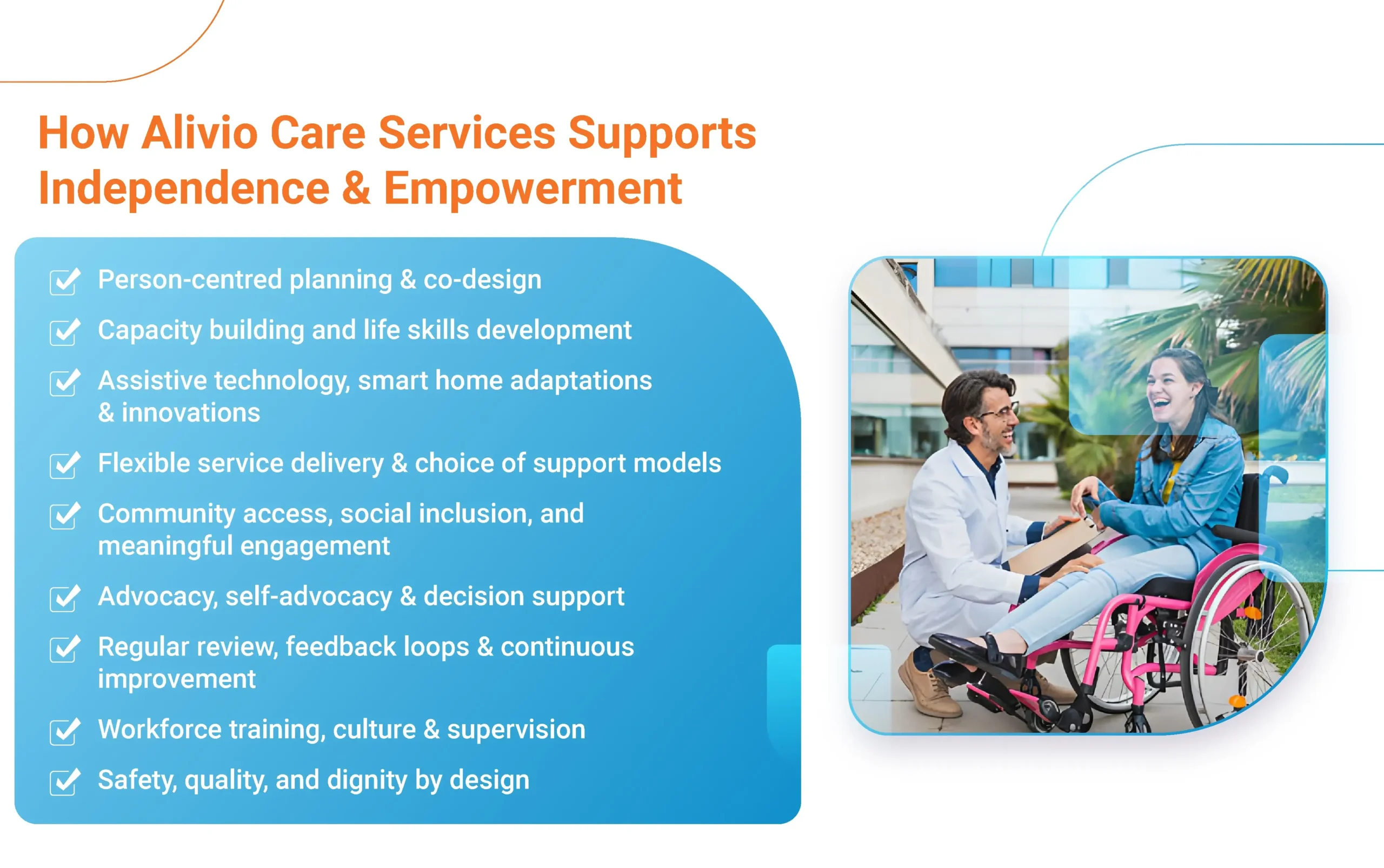
Below are the key domains and mechanisms by which Alivio Care Services (or any well-designed provider) can foster independence and empowerment for NDIS participants:
1. Person-centred planning & co-design
One of the first and most critical steps is co-designing a support plan with the participant (and their support circle) that is anchored in their aspirations, strengths, preferences, and goals. A provider committed to empowerment ensures:
- The participant leads the conversation about their goals (for example, independence in daily living, social participation, employment, mobility, etc.).
- Options are presented, and alternatives respected — participants have choice in workers, times, methods, and intensity.
- Regular reviews and adjustments are made, so as goals evolve or capacities change, the plan evolves too.
Alivio Care Services (via their website) should promote this as a core value, indicating their readiness to listen, adapt, and co-create supports.
2. Capacity building and life skills development
A service that only does things for participants may inadvertently foster dependence. A better approach is to grow ability. Key strategies include:
- Task breakdown & graded support: E.g. instead of full assistance with a complex task, the support worker might guide partial completion while the participant does the rest. Over time, the participant does more themselves.
- Skill training modules: For cooking, budgeting, transport, shopping, hygiene, communication, digital literacy, etc.
- Encouraging safe risk-taking: Support workers helping participants test new skills (within safety parameters) rather than over-protecting them.
- Goal-oriented challenges: Setting incremental goals (e.g. independently managing one new task per week) to gradually build self-efficacy.
Through capacity building, the participant grows confidence, reduces reliance on support, and gains more independence.
3. Assistive technology, smart home adaptations & innovations
In 2025, assistive technology, smart home systems, and wearable devices play a transformative role in enabling independence.
A provider like Alivio Care can support:
- Assessment of assistive devices (mobility aids, communication aids, smart sensors)
- Integration of smart home equipment (voice assistants, automated lighting/doors, environmental controls)
- Training in use and troubleshooting of such tech
- Monitoring and adjusting tech solutions over time
By leveraging technology, participants can do more tasks themselves (e.g., turning lights on/off, controlling windows, or setting alarms), reducing direct human support time but increasing autonomy.
4. Flexible service delivery & choice of support models
Flexibility is a hallmark of empowerment. A rigid schedule or a “one-size-fits-all” model constrains participants. Instead, Alivio Care should enable:
- Flexible scheduling (morning, evening, split visits)
- Choice of support workers (match by personality, skill, or cultural/language fit)
- Mix of in-home, community-based, remote, or tele-support as needed
- Options of short-term or burst supports (when the participant needs extra help)
This flexibility honours the participant’s lifestyle preferences and reduces the feeling of being “captive” to a provider’s schedule.
5. Community access, social inclusion, and meaningful engagement
True independence is not just physical daily tasks; it’s being part of community life. Providers must help participants access:
- Social and recreational activities
- Volunteering or employment opportunities
- Support in navigating public transport
- Help in building social skills and relationships
When support enables more community connection, not only does the participant feel empowered, but social inclusion increases, isolation decreases, and quality of life improves.
6. Advocacy, self-advocacy & decision support
Participants may need support to stand up for their rights, navigate complex systems, or make choices. Good providers help:
- Educate participants (and families) about NDIS rights, provider obligations, and appeals processes
- Assist in reviews, plan negotiations, or service transitions
- Provide decision-making supports (e.g. helping weigh options, pros/cons, using visual aids)
- Promote self-advocacy: encouraging the participant to speak up, provide feedback, and choose
This helps shift power towards the participant rather than the provider dominating decisions.
7. Regular review, feedback loops & continuous improvement
Empowerment means listening and adapting. Alivio Care should incorporate:
- Structured feedback mechanisms (surveys, interviews, suggestion boxes)
- Regular support plan reviews (quarterly, bi-annual)
- Transparent metrics of outcomes. e.g., how many goals achieved, improvements in independence
- Willingness to pivot or change approaches if not working
This ensures support remains relevant, effective, and tailored to evolving needs.
8. Workforce training, culture & supervision
Even the best design fails without appropriate staff. To support independence & empowerment:
- Staff must be trained not only in technical skills but also in motivational interviewing, positive behaviour support, communication, and cultural competence
- Supervision should emphasise coaching rather than instruction or control
- A supportive, flexible workplace culture where staff feel valued ensures better person-centred care
- Staff turnover must be minimised to allow continuity and relational trust
A provider like Alivio Care Services should highlight its workforce approach and training philosophy on its website as a mark of quality.
9. Safety, quality, and dignity by design
Empowerment does not mean removing safeguards. Good practice ensures:
- Risk assessments that balance safety with opportunity
- Transparent boundaries and guidelines, co-developed with participants
- Compliance with NDIS Quality & Safeguards Commission rules (the NDIS Commission regulates providers for safety & quality)
- Clear complaint and redress mechanisms
This approach ensures that the pursuit of independence does not compromise well-being.
Putting It All Together: A Hypothetical Participant Journey with Alivio Care Services
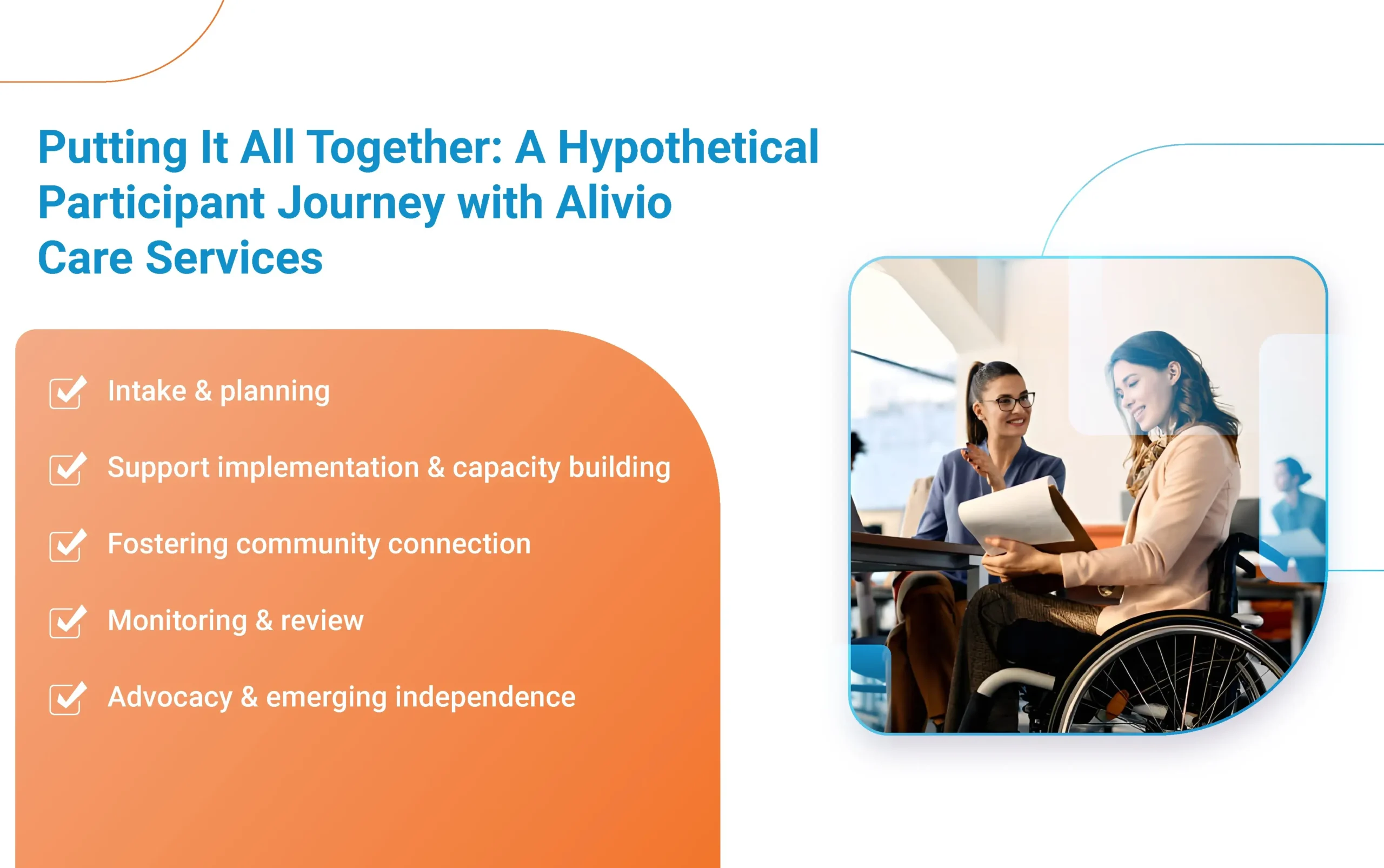
To illustrate, here is how a typical participant might engage with Alivio Care Services in a way that supports empowerment:
- Intake & planning
- A person with physical disability applies to become an NDIS participant
- They choose Alivio Care Services (via their website) as one provider
- In the first meeting, Alivio staff spend time learning about the person’s dreams, routines, challenges, preferences
- Together, they co-design a support plan: e.g., the goal is to increase independent showering, attend community center twice a week, manage medication, learn budgeting
- Support implementation & capacity building
- Initially, staff accompany the participant and gradually step back, providing prompts rather than full help
- Assistive devices (grab rails, shower chair, voice control for bathroom lighting) are installed and participant is trained
- The support worker helps the participant plan a route to the community centre, gradually reducing physical assistance
- Fostering community connection
- Alivio arranges to connect the participant with local groups (arts classes, support groups)
- They support transport planning and assist socially if needed
- Monitoring & review
- After a few months, they review progress: participant may now shower with minimal assistance and attend community class independently
- The plan is updated: next goals could be small volunteering, improving cooking skills, more outings
- Advocacy & emerging independence
- The participant identifies they want to change support workers because of personality mismatch
- Alivio accommodates the change without undue friction
- The participant begins to exercise more control over their schedule and receives support for self-advocacy training
This pathway shows how a provider that focuses on empowerment supports growth, rather than just doing tasks for a client.
Why Choosing the Right NDIS Service Provider Matters
When choosing among NDIS service providers, especially for disability care, the difference in ethos, quality, and flexibility matters a lot. Here are some reasons why Alivio Care Services may stand out (assuming they deliver on these promises):
- Alignment with empowerment philosophy: A provider that highlights independence, choice, and growth in their messaging suggests they adopt more than task-based care.
- Transparency and accessibility: Their website should clearly present services, staff credentials, participant rights, feedback and complaints processes.
- Service breadth and integration: A capable provider offers a spectrum such as personal care, community participation, assistive tech, life skills, and support coordination, allowing continuity and synergy.
- Quality assurance & compliance: Because the NDIS Commission regulates providers, Alivio should be registered, demonstrate audits, and comply with quality and safeguarding requirements.
- Positive testimonials and case studies: Real-life stories or reviews can show how the provider has helped participants grow in independence.
- Ongoing innovation & adaptation: Providers that stay current with trends (assistive tech, smart home, telehealth) are more likely to help participants stay ahead.
If Alivio commits to these, it can become a trusted partner for many individuals and families.
Trends & Innovations in Disability Care that Reinforce Empowerment
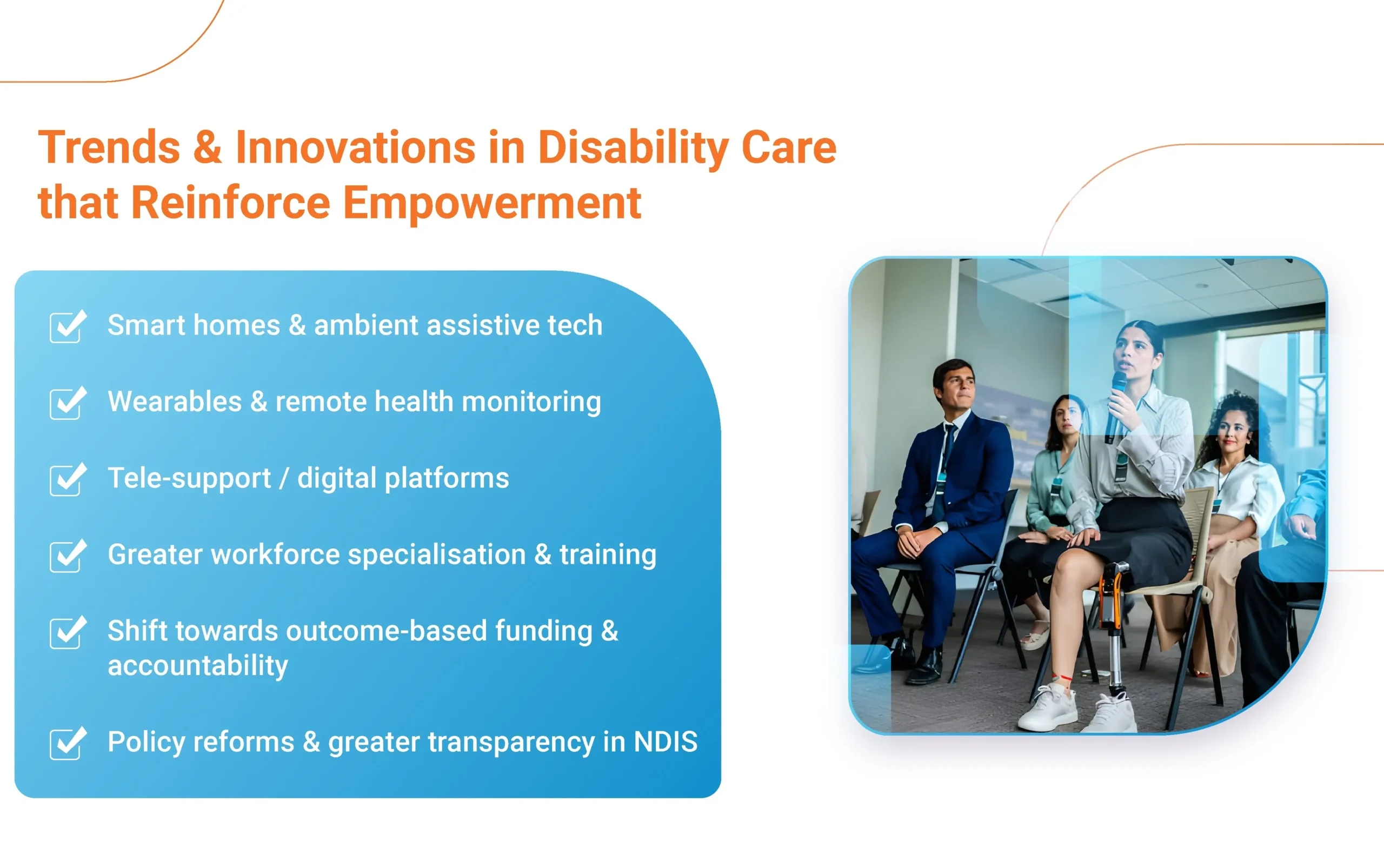
To remain aligned with best practice, providers must keep up with evolving trends. Here are noteworthy trends and how they connect to empowerment:
1. Smart homes & ambient assistive tech
Automation, sensors, and voice-controlled systems help participants do things autonomously (turning on lights, doors, and environmental controls).
2. Wearables & remote health monitoring
Devices that monitor health or alert support staff in case of anomalies reduce risk while maintaining autonomy.
3. Tele-support / digital platforms
Remote coaching, check-ins, and digital planning tools reduce travel burden and provide quicker support touchpoints.
4. Greater workforce specialisation & training
Disability support workers are increasingly required to have specialised training (e.g., positive behaviour support, mental health, complex care).
5. Shift towards outcome-based funding & accountability
Providers are more often evaluated on participant outcomes (how independent participants become) than just hours delivered. This encourages empowerment-focused services.
6. Policy reforms & greater transparency in NDIS
Ongoing updates aim to streamline assessments, improve consistency, and emphasise functional capacity.
By staying current, Alivio Care Services can be better positioned to deliver supports that truly enhance independence rather than defaulting to “doing for”.
Potential Challenges & How to Address Them
While striving for empowerment is laudable, there are real challenges. A provider should anticipate and address them:
| Challenge | Potential Risks | Mitigation Strategies |
| Overprotection/under-challenge | Participant stagnates, reliance entrenched | Use graded scaffolding, safe risks, and frequent reviews |
| Resource constraints (staffing, funding) | Inability to provide desired flexibility | Lean models and tech support, prioritise capacity building |
| Technology adoption barriers | Devices may fail, or participants may resist | Provide training, backups, and fallback manual options |
| Misalignment of expectations | Provider and participant disagree on pace or support levels | Early and ongoing communication, shared decision-making |
| Safety vs autonomy trade-offs | Risk of injury, harm if too little oversight | Co-developed risk plans, dynamic assessment, supervision |
| Staff turnover or inconsistency | Disruption of relationships and trust | Invest in staff retention, cross-training, good culture |
| Regulatory or compliance constraints | Some supports may be limited by NDIS rules | Stay updated with NDIS Commission guidelines, document thoroughly |
A recognised provider (like Alivio) must openly acknowledge such challenges and describe how it mitigates them.
How You (as a Participant or Family) Can Maximise Independence & Empowerment with a Provider
Even with the best provider, success depends also on what the participant or their support network does:
- Clarify your goals: Before engaging, reflect on your personal aspirations (not just needs), e.g., learning, social life, employment, and travel.
- Be proactive and engaged: Attend planning sessions, voice preferences, ask questions, and request reviews.
- Track progress: Keep a journal or log of improvements, challenges, and desired changes.
- Use choice & feedback: Don’t be afraid to switch support workers, adjust schedules, or raise concerns.
- Push for growth: Ask your provider to teach you skills, not just “do for you”.
- Be open to technology: If a device or app can make you more independent, give it a try.
- Advocate for yourself: Learn about your rights under the NDIS, and engage with participants’ networks or advocacy groups.
When participants are active co-pilots rather than passive passengers, the empowerment effect magnifies.
Why Register with Alivio Care Services for Your Disability Care
If you are an NDIS participant (or will be) looking for disability care support that genuinely promotes independence and empowerment, here’s why Alivio Care Services is a compelling option to explore:
-
- They can (or should) operate as a registered NDIS service provider with a commitment to quality, compliance, and safety.
- Their ethos (as you present on their site) can emphasise person-centred, growth-oriented care rather than mere service delivery.
- They can offer a range of supports, personal care, life skills, community participation, and assistive tech in an integrated fashion.
- Their culture and staffing practices can be aligned with autonomy, feedback, and continuous improvement.
- They can evolve with you: as your goals and capacities shift, the supports adapt, not remain static.
If you like, you could visit their website, request a meeting, ask for testimonials, and see how they might tailor a plan for you. This approach ensures you get a provider who supports you in becoming more independent, not someone you depend on forever.
FAQs
1. What makes a provider truly “empowerment-oriented” rather than just a care deliverer?
Ans: A provider with an empowerment orientation centres the participant in decision-making, promotes growth of skills, offers choice and flexibility, listens to feedback, embraces technology, and designs supports to reduce reliance, rather than just providing tasks. It shifts the power balance towards the person rather than the provider.
2. Can assistive technology and smart home devices really reduce the need for human support?
Ans: Yes, in many cases, assistive tech, environmental controls, voice-activated systems, sensors, and automation can allow participants to perform tasks independently (or with minimal prompting), thereby reducing direct support hours while increasing autonomy. However, tech must be appropriate, reliable, and integrated with care routines.
3. What if I don’t like a support worker or the schedule proposed by the provider?
Ans: A good provider should allow you to change workers or schedules, respecting your preferences and comfort. This is part of choice and control. You should raise it early, and any reputable provider (such as Alivio) would work with you to find a better match.
4. How often should my support plan be reviewed or updated?
Ans: Best practice is periodic reviews, often quarterly or biannually, to evaluate progress, reassess goals, adjust supports, and ensure relevance. Some dynamic tweaks may occur more frequently in response to changes.
5. Could focusing too much on independence create safety risks?
Ans: Safety must be balanced with autonomy. A provider should co-design risk plans, use gradual steps, include fallback supports, closely monitor, and avoid overly cautious restrictions. The goal is safe risk-taking, not eliminating all risk.
6. What if my NDIS plan changes or funding is redirected, and how will that affect my provider relationship?
Ans: A responsive provider should help you navigate transitions: adjusting support levels, negotiating with NDIA, prioritising core services, and aligning with new plan parameters. You should choose a provider who demonstrates the capacity to adapt to plan changes.
7. How do I know that Alivio Care Services (or any provider) is properly registered and trustworthy?
Ans: You can check:
- That the provider is listed on the NDIS Provider Finder as registered
- That they comply with NDIS Quality & Safeguards requirements
- That they share audit or accreditation evidence, transparent feedback/complaint mechanisms, participant testimonials, and staff qualifications
- Ask for references or speak with existing participants